Growing up in northern Ghana, Latifa Chimsi Abdulai witnessed the profound impact her father had on their community. As a respected local chief, he fiercely championed the protection of shea trees, recognising their essential role in sustaining women’s livelihoods. He used his authority as a chief to actively discourage the cutting of trees and the burning of parklands across his jurisdiction. By protecting the shea trees that sustained women’s livelihoods, he ensured kernels remained abundant, enabling women under his chieftaincy to gather close to home, without the need for long, arduous journeys.
However, with new leadership came a retreat from earlier commitments. Parklands were increasingly burned, shea trees cut down, and land repurposed, eroding the foundation of women’s livelihoods.
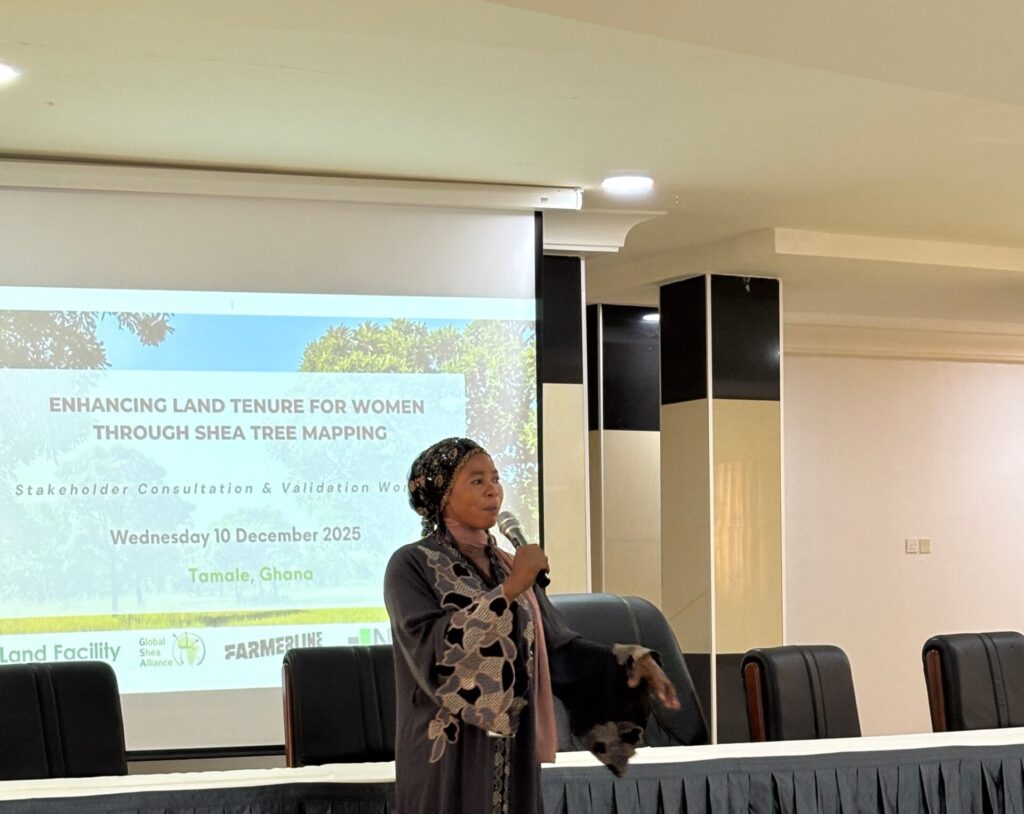
Today, the empty spaces across the landscape are a powerful reminder of the escalating challenges women face in sustaining their incomes and traditions. Latifa is a member of Wundua Bangbeebu Women’s Co-operative. Her co-operative supplies high-quality shea kernels to major global buyers, helping to connect local efforts to international markets. Hence, she knows preservation is key. Latifa is mobilising her co-operative to engage chiefs, local authorities and community leaders, helping to restore traditional protections and promote collective responsibility for preserving shea parklands for future generations.
Global Shea Alliance
Innovative digital and legal tools are at the core of the Enhancing Women’s Land Tenure through Shea Tree Mapping project, which uses digital shea tree mapping, mobile data and legal gap analyses to strengthen women’s land and tree rights. The project is implemented through a collaboration between the Global Shea Alliance, Farmerline, New Markets Lab and Level4International and is funded by the UK Foreign, Commonwealth and Development Office (FCDO) through its flagship
Through the Land Facility programme, over 16,000 shea trees have been digitally mapped across Ghana, Togo and Benin and linked to more than 3,500 women producers. This integration brings together shea tree data and land tenure information to directly inform conservation decisions while strengthening women’s land and tree claims. In parallel, legal gap analyses make rights clearer and enforceable, unlocking access to finance and enabling women to invest with confidence and security in their businesses.
About the Global Shea Alliance
The Global Shea Alliance (GSA) promotes industry sustainability, quality practices and standards, and demand for shea in food and cosmetics. GSA is a non-profit, multi-stakeholder platform with 560 members from 35 countries representing all shea stakeholder ground including women’s groups, supporters, international oils and fat suppliers, and leading food and cosmetic brands. Through public private partnerships, GSA promotes industry sustainability, quality practices and standards, and demand for shea in food and cosmetic products.